
What Does an Ankle Foot Orthosis (AFO) Do?
Updated: Sep 29
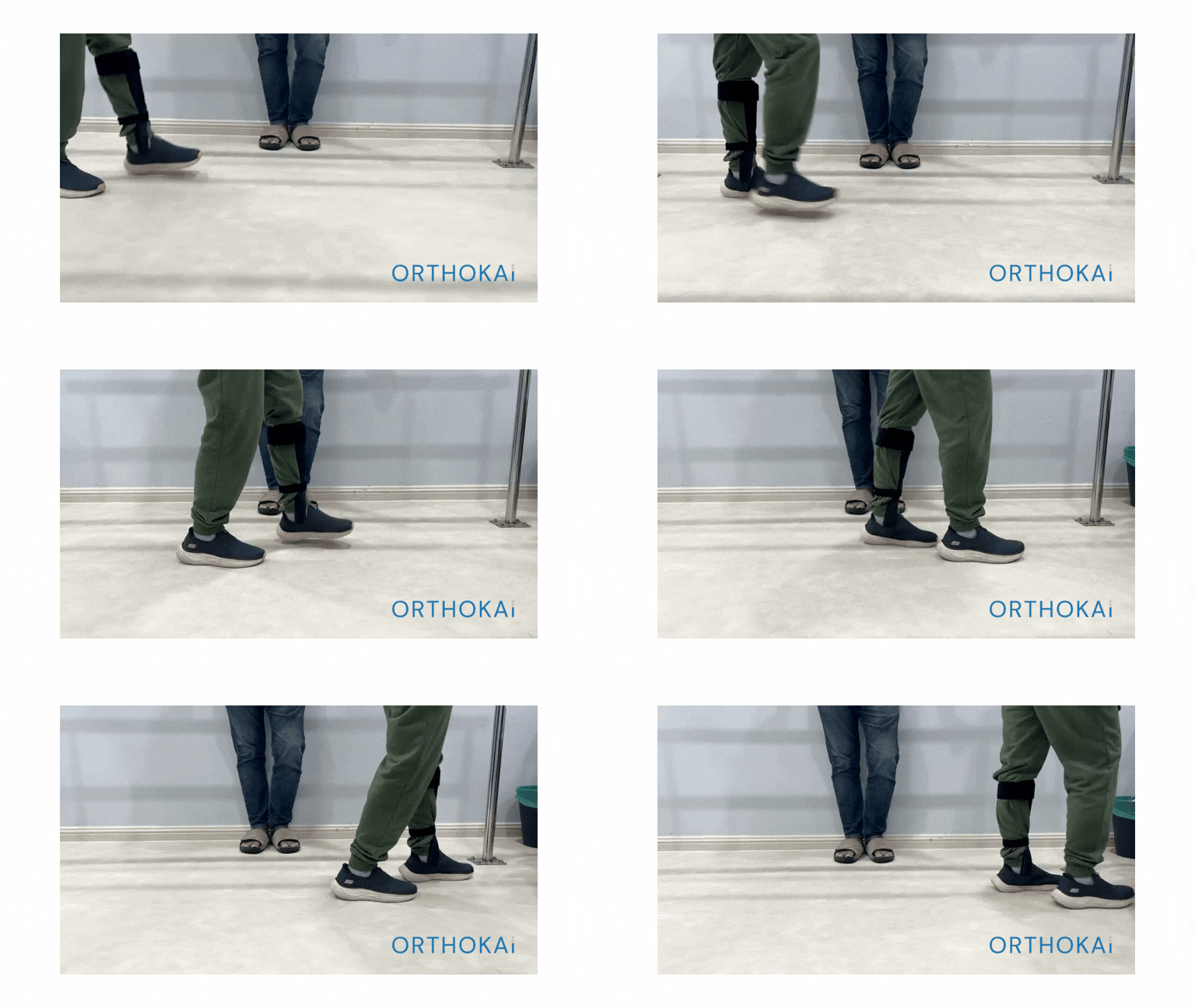
Imagine taking your first step in the morning and your foot simply… doesn't respond the way it should. Your toes drag. Your ankle buckles. Something that every other person around you does without a second thought, walking, has become an exhausting, uncertain act that takes all of your concentration.
For many people living with neurological conditions, stroke, or nerve injuries, this is not a hypothetical. It is Tuesday morning.
An Ankle Foot Orthosis (AFO) doesn't give people their old life back. It gives them a new one and often, a better one than they thought was possible.
What Is an AFO?
An AFO, short for Ankle Foot Orthosis, is a supportive brace that fits around the lower leg, ankle, and foot. It is worn inside a shoe and designed to control, correct, or support the ankle and foot when the muscles or nerves responsible for movement are not functioning as they should.
The name tells you exactly where it works: ankle and foot, with an orthosis (from the Greek word for "to straighten" or "to correct") doing the work your muscles cannot.
AFOs are one of the most commonly prescribed orthotic devices in the world and one of the most life-changing.
Who Needs an Ankle Foot Orthosis?
AFOs are prescribed for a wide range of conditions that affect the lower limb. The common thread is this: when the communication between the brain, nerves, and muscles of the ankle and foot breaks down, an AFO steps in as a mechanical bridge.

Rebound Orthotics & Prosthetics. (2025, March 10). Foot drop: Causes, symptoms, and treatment options [Illustration]. https://www.reboundoandp.com/blog/foot-drop-causes-symptoms-and-treatment-options
Conditions commonly managed with an AFO include:
Foot drop — where weakness or paralysis prevents the foot from lifting properly during walking, causing the toes to drag on the ground
Stroke — many stroke survivors experience weakness on one side of the body, including the ankle and foot
Cerebral palsy — children and adults with cerebral palsy often have altered muscle tone that affects how the foot and ankle function
Multiple sclerosis (MS) — MS can cause muscle weakness and spasticity in the lower limb
Charcot-Marie-Tooth disease — a hereditary nerve condition that progressively weakens the muscles of the lower leg and foot
Spina bifida — a condition present from birth that can result in varying degrees of lower limb weakness
Post-surgical recovery — following certain orthopaedic surgeries, an AFO can protect and support the ankle during healing
And many more conditions not listed. Our team at OrthoKai will always assess each person individually — the condition is just the starting point. What matters most is your anatomy, your goals, and your daily life.
What Does an AFO Actually Do?
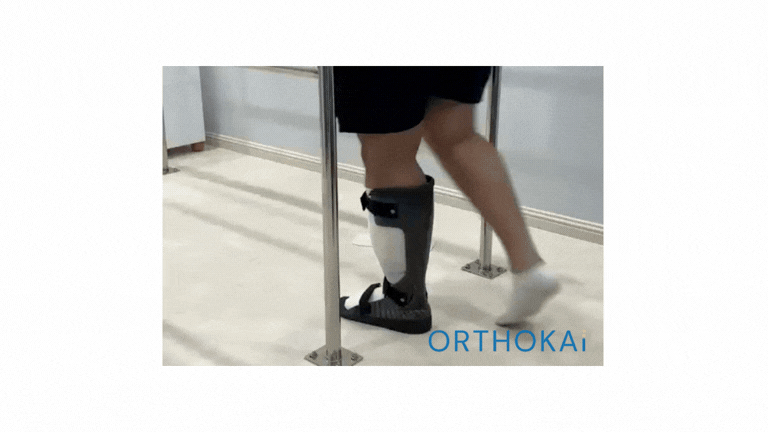
At its core, an AFO performs one or more of the following functions, depending on how it is designed:
1. Controls foot drop This is perhaps the most well-known application. When the muscles that lift the front of the foot are weak or paralysed, the foot cannot clear the ground during the swing phase of walking. An AFO holds the foot at the correct angle, preventing the toes from dragging and significantly reducing the risk of trips and falls.
2. Provides stability The ankle joint bears enormous forces with every step. When ligaments are lax, muscles are weak, or the joint itself is unstable, an AFO can brace the ankle from the sides — giving you a stable base to walk from.
3. Corrects alignment Over time, muscle imbalances or neurological conditions can pull the foot and ankle into abnormal positions — turning inward, turning outward, or rolling at the heel. An AFO applies gentle, consistent corrective force to guide the foot into a better position, protecting joints and reducing compensatory strain on the knees, hips, and back.
4. Reduces energy expenditure An inefficient gait costs energy. When the foot and ankle are not working properly, the body compensates in ways that are tiring and unsustainable. A well-fitted AFO can dramatically reduce this energy cost, allowing people to walk further and with less fatigue.
5. Protects the foot and ankle For patients with reduced sensation — such as those with diabetic peripheral neuropathy — an AFO can help redistribute pressure and protect vulnerable areas of the foot from injury.
What Types of AFO Are There?
Not all AFOs are the same. The right design depends entirely on what your ankle and foot need. Broadly, there are several categories:
Solid AFO: a rigid brace that holds the ankle in a fixed position. Used when maximum control is needed, such as in severe foot drop or high muscle tone.
Hinged (Articulated) AFO: features a hinge at the ankle joint, allowing some degree of movement while still providing support. This can feel more natural for walking and is often preferred when the patient has some residual ankle function.
Posterior Leaf Spring (PLS) AFO: a slimmer, flexible brace that uses the spring properties of the material to assist foot clearance. Suitable for milder foot drop with good mediolateral stability.
Carbon Fibre AFO: lightweight, strong, and responsive, carbon fibre AFOs are increasingly popular for active users. They store and release energy with each step, making walking feel more dynamic and natural.
Sock AFO: a newer innovation in ankle-foot orthoses, designed like a supportive sock for a lightweight, low-profile fit. It provides dynamic assistance for mild foot drop while maximizing comfort, flexibility, and ease of wear, making it suitable for everyday use.
Custom vs. Ready made: a ready made (off-the-shelf) AFO can work for temporary conditions or mild presentations or those made with carbon fiber which not only helps keep the foot from droping but also pushes the foot up when walking. A custom-made AFO, however, is moulded directly from a cast or scan of your limb — ensuring a precise fit that a generic product simply cannot replicate.

At OrthoKai, we specialise in custom-fabricated AFOs tailored to each person's specific anatomy and functional goals. The difference a properly fitted brace makes — versus one that is "close enough" — can be the difference between walking comfortably all day and giving up after twenty minutes.
What Should I Expect When Getting an AFO?
Getting an AFO is not a one-visit process, and it should not be. A proper fitting involves:
Assessment — your orthotist will evaluate your walking pattern, muscle strength, range of motion, and the specific challenges you face
Casting or scanning — for a custom device, an impression of your limb is taken so the AFO can be fabricated to your exact shape
Fabrication — the brace is made from materials chosen to match your functional needs
Fitting and adjustment — once the AFO is ready, you will try it on, walk in it, and the orthotist will make any adjustments needed to ensure comfort and function
Review — follow-up appointments check that the AFO is performing as intended and that your needs have not changed
This is a collaborative process. The goal is not simply a brace — it is a better quality of life.
How OrthoKai Can Help

Our team of certified orthotists at OrthoKai has extensive experience in assessing and fitting AFOs for patients of all ages and across a wide range of conditions. We work with adults and children, post-stroke patients, individuals with neurological conditions, and those recovering from orthopaedic procedures.
We take the time to understand not just your diagnosis, but your life — what you want to do, what you've been struggling with, and what "better" looks like for you.
If you or someone you care about is experiencing foot drop, ankle instability, or difficulty walking, we'd be glad to help you explore your options. Learn more about our lower limb orthotics services or book an appointment at our clinics in Kuala Lumpur, Johor Bahru, or Singapore.
You don't have to figure this out alone. Our team is here.
Frequently Asked Questions About AFOs
Is an AFO the same as a leg brace?
"Leg brace" is a general term that people use for many different devices. An AFO is a specific type of orthosis that supports the ankle and foot — it extends from just below the knee to the bottom of the foot. Other "leg braces" such as a KAFO (Knee Ankle Foot Orthosis) extend further up to support the knee as well.
Can I wear an AFO in my normal shoes?
In most cases for ready made AFOs, yes — though you may need to size up by half a size or one full size to accommodate the brace comfortably. Your orthotist will advise you on suitable footwear and may have recommendations for shoe styles that work well with your specific AFO design. However a customize AFO is generally made to be walked in as it, without a shoe, as it has anti slip attach to the bottom as well.
How long will I need to wear an AFO?
This depends entirely on the underlying condition. Some people wear an AFO temporarily during recovery. Others, particularly those with permanent neurological conditions, wear one long-term as an essential part of daily life. Your orthotist will discuss this with you as part of your overall care plan.
At OrthoKai, we believe that every step matters. If you have questions about AFOs or any of our orthotic services, don't hesitate to reach out — we're always happy to have a conversation.


