
Above-Knee Prosthesis: How A Good Socket Fitting, Right Knee Components and Proper Rehabilitation can Affect Your Daily Mobility

There is a moment many above-knee amputees describe, standing upright for the first time with a prosthesis, feeling both the weight of what has changed and the quiet possibility of what might still be. It is not a small moment. Neither is the road that follows.
Losing a limb above the knee, known medically as a transfemoral amputation, reshapes how you move through everyday life. Getting dressed in the morning. Walking to the kitchen. Climbing a flight of stairs. Things that once happened without a second thought now require relearning, patience, and the right support around you.
But here is what is also true: with the right prosthesis and the right guidance, many people go on to walk, navigate stairs, return to work, and live full, active lives. The key lies in getting three things right — the socket fit, the knee component, and the rehabilitation process.
Why Socket Fit Is the Foundation of Everything

The socket is the part of your prosthesis that your residual limb sits inside. It is custom-moulded to your specific shape, and it is arguably the most important element of the entire device. A poorly fitting socket affects not just your comfort, but your stability, your skin health, and how well you can walk.
A well-fitted socket does several things: it keeps the prosthesis firmly attached to your body, distributes pressure evenly across your residual limb, and allows your hip muscles to control the knee and foot below. When the fit is off, you might experience redness, blisters, or skin breakdown, and you will likely compensate with your gait in ways that lead to back and hip pain over time.
One important thing to understand is that your residual limb will change shape significantly in the first six to twelve months after amputation. Swelling decreases, muscles shift, and the limb continues to settle. This is why your prosthetist may start you on a temporary socket before fitting a permanent one, and why regular check-ups and adjustments are not optional extras. They are essential.
Common suspension methods for above-knee sockets include suction suspension, pin and liner systems, and vacuum-assisted systems. Your prosthetist will guide you to the right option based on your anatomy, activity level, and comfort preferences.
Choosing the Right Prosthetic Knee
Above-knee prostheses require an artificial knee joint and the type of knee unit you use has a major impact on how naturally and safely you move.

There are three main categories to understand:
Basic mechanical knees — Simple, durable, and generally more accessible in cost. These are stable and reliable for lower-activity users, but they require the user to actively control the knee by engaging the hip extensors to lock it in place during walking.
Hydraulic and pneumatic knees — These adapt to different walking speeds more smoothly than basic mechanical knees, offering better comfort and a more natural gait for moderately active users.
Microprocessor-controlled knees (MPK) — The most advanced option. These use sensors and onboard processors to continuously adjust the knee's resistance in response to your movement in real time. Research has shown that users of microprocessor knees demonstrate significant improvements in both gait and balance compared to those using mechanical alternatives, with a more natural walking pattern and reduced risk of falls.
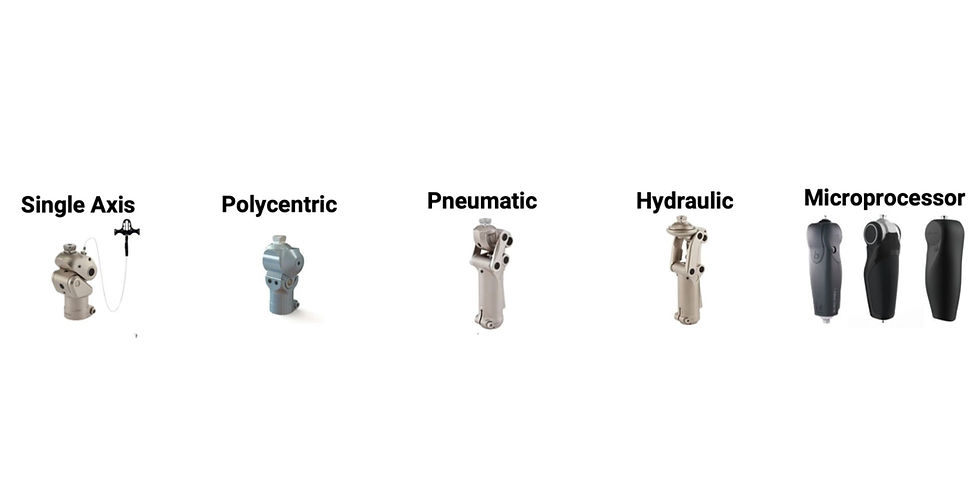
The right knee for you depends on your activity level, your rehabilitation goals, your body weight, and your daily environment. If you navigate varied terrain, ramps, uneven ground, stairs, the adaptability of a higher-specification knee component can make a meaningful difference to your confidence and safety.
Rehabilitation: Where the Prosthesis Becomes Part of You
Even the best-fitted prosthesis with the most advanced knee component will not deliver results without dedicated rehabilitation. For above-knee amputees, this journey is longer and more involved than for below-knee users — precisely because the knee joint must be learned and controlled.
Rehabilitation typically begins well before your prosthesis is fitted. In the early post-operative phase, the focus is on managing swelling (often with a residual limb shrinker), maintaining strength in the hip and core muscles, and preventing joint contractures — stiffness that can limit how well your prosthesis fits and functions later.

Once you receive your prosthesis, a physiotherapist experienced in amputee rehabilitation will guide you through progressive gait training. This includes:
Weight shifting and balance exercises — learning to trust the prosthesis under your body
Overground gait training — building a safe, efficient walking pattern
Stair and ramp navigation — typically leading with the sound leg going up, and with the prosthetic leg coming down
Hip extensor and flexor strength is particularly important for above-knee prosthesis users. Weak hip muscles limit the control you have over your prosthetic knee, which in turn limits which knee components are suitable for you, and your overall functional ability. Strength training your residual limb and surrounding musculature is not just rehabilitation, it is what unlocks better outcomes long-term.
Recovery is rarely linear. There will be days that feel like setbacks. But with a prosthesis that has been properly fitted and selected, and with consistent effort in therapy, progress is absolutely achievable.
How OrthoKai Can Help

At OrthoKai, our prosthetists work with you from the very beginning — assessing your strength, your lifestyle, and your goals, to design an above-knee prosthesis that fits your life, not just your limb. We take the time to select the right socket design, suspension system, and knee component for where you are now, and where you want to get to.
As part of our prosthetics service, we also guide you through gait training, helping you build confidence and function with your new device from the very first fitting. Whether you are taking your first steps post-amputation or looking to upgrade your current prosthesis, we are here to support you.
We see patients across our centres in Singapore, Kuala Lumpur and Johor Bahru. If you would like to explore your options or simply ask a question, our team is happy to help, no pressure, no rush.
Frequently Asked Questions
How long does it take to learn to walk with an above-knee prosthesis?
The timeline varies for everyone, but most people begin gait training within a few weeks of receiving their first prosthesis. Significant progress typically happens over several months of consistent therapy and practice. Factors like overall fitness, hip strength, and the type of knee component used all play a role.
Will my socket need to be replaced?
Yes — as your residual limb changes shape (especially in the first year), your socket will need to be adjusted or remade. Prosthetic sockets generally require replacement more frequently than other components. Regular follow-up appointments with your prosthetist help ensure your fit remains optimal.
Is a microprocessor knee right for me?
It depends on your activity level and mobility goals. MPK knees offer significant advantages for moderately to highly active users, particularly for varied terrain and stair use. Your prosthetist will assess your functional level and recommend the most appropriate option for your lifestyle.


